Posts

Bioinformatics- Assignment 8

Summary of GTEx track Description of data: A median of gene expression levels was taken from 52 tissues and 2 cell lines, based on RNA-seq data from the GTEx final data release in August 2019. This release was based on data from 17,382 tissue samples obtained from 948 adult post-mortem subjects. Methods: Tissue samples were collected using the GTEx standard operating procedures in partnership with the National Cancer Institute Biorepositories and Biospecimen. All obtained tissue samples were reviewed by pathologists in order to characterize and verify organ sources. That being said, the RNA-seq was conducted by the GTEx Laboratory, Data Analysis, and Coordinating Center. While the sequences were conducted using the STAR v2.5a assisted by the GENCODE 26 transcriptome definition. Finally, gene annotations were produced using a custom isoform collapsing procedure. Subject and Sample Characteristics: The donors of this study and their biospecimen were required to show no evidence of diseas...

Bioinformatics- Assignment 8| UCSC Genome Browser

Image
Assignment 8 had me get acquainted with the UCSC genome browser, which is saturated with all different kinds of genomic information. I looked up my protein AMY1B and explored its genetic sequence along with some other loci on the same chromosome. That being said, when I filtered what was displayed in the data track to "NCBI RefSeq" my data track shrunk significantly, only displaying one gene body. When I clicked on the gene body it took me to a new window that listed the specifics of the gene that I had already read about in previous databases used. Taking note of this, it showed me how meticulous these databases strive to be in putting out information. Below is the best image I could get of the initial data track displayed in the UCSC genome browser. 

Bioinformatics- Assignment 7| CollecTF Database

The three different species of bacteria: - Firmicutes - Clostridia - Clostridiales Ecosystem details: Digestive system -> Large intestine -> Fecal Transcription factor, CsoR.  Motif - Inverted repeat  G/C content - 69.23% Regulatory mode - Activation 0%, Repression 100%, Dual 0%, Not specified 0%. TF conformation - Monomer 0%, Dimer 0%, Tetramer 100%, Other 0%, Not specified 0%. Binding site type - Motif-associated 1, Variable-motif-associated 0, Non-motif-associated 0.  The specific type of gene regulation this transcription factor is involved in I couldn't determine. However, I'm inclined to say, TTHA.

Bioinformatics- Assignment #6

P04745-Alpha-amylase 1 Uniprot ID: AMY1_HUMAN Protein: Alpha-amylase 1 Gene: AMY1A Diseases associated with alpha-amylase: None to be noted. Catalytic activity: Endohydrolysis of (1->4)-alpha-D-glucosidic linkages in polysaccharides containing three or more (1->4)-alpha-linked D-glucose units. Cofactor: Calcium ion (Ca2+) and Chloride ion (Cl-) Alpha-amylase was found to be rather mildly expressed exclusively in the pancreas. No other organs/regions could be noted.  Some aspects of alpha-amylase I am curious about are, one, why is there such little data about it? Two, why would it be expressed only in the pancreas and not somewhere along the digestive tract?  One project idea I have in mind is further investigating where else alpha-amylase could possibly be expressed, and discovering why it is expressed higher in one region than another. 

Bioinformatics- Assignment #5 (week 5)

The top three results for the Gene-Disease Associations for my protein were the following: -   Evidence for AMY1B in integumentary system disease                -Association score: 0.508836 -   Evidence for AMY1B in neoplasm of the thorax                            - Association score: 0.5086579             - Evidence for AMY1 in glandular cell neoplasm              - Association score: 0.50802636 The top three diseases:   Title: Salivary Alpha-Amylase Reactivity in Breast Cancer Survivors   Authors: Wan C, Couture-Lalande MÈ, Narain TA, Lebel S, Bielajew C   Summary of Abstract: This study looked at two primary components of the stress system which are the hypothalamic-pituitary-adrenal (HPA) and the sympathetic-adrenal-me...

Bioinformatics- Assignment #4 (Week 4)

 Hello, Today I explored the website interactome and STRING. While exploring these websites I searched up my assigned protein AMY1B and looked specifically at its different interactions. I first searched up AMY1B in interactomes database and in doing so, found that it interacted with the protein Mucin-7 or MUC7, which functions to promote the clearance of bacteria in the oral cavity. With that being said, I then searched up AMY1B on the website STRING, and it was here I found a series of different interactions with other proteins. Some of which were, H6PD, LCT, MGAM, and BPI just to name some.  After, looking at the two websites I found that they both had very different results. For instance, interactome had only one interaction listed while STRING had a total of eight interactions! However, out of those eight interactions, only four were determined experimentally whereas the other remaining four were from curated databases.  In closing, after exploring interactome and ST...

Bioinformatics - Assignment #3 (Week 3)

Image
 Hello, Today I familiarized myself with iTASSER, which is a platform that uses algorithms to construct models of specific proteins that are being investigated. The protein I requested a model of belonged to Deinococcus Radiodurans, D. rad, and had the following locus tag Ga0133345_1136. Below are four images of the protein rotating through space.  

Bioinformatics - Assignment #2 (Week 2)

Image
Hello everyone,  Below you will find some more information I was able to discover about my protein, alpha-amylase 1B. Locus tag : NM_001008218 Size : 1838 bp Accession number : NM_001008218 Version : NM_001008218.1 Comment : REVIEWED REFSEQ: This record has been curated by NCBI staff. The reference sequence was derived from CB958705.1, CB957894.1, CB958435.1, and AI627716.1.   Comparing the information from NCBI and the information I used for the first assignment, the only discrepancy I can note is that NCBI gives the length in “base pairs” while the website protein atlas gives the length in “amino acids”. Graphic summary of my BLAST run                                                                            My first two sets of primers

Bioinformatics - Assignment #1 (Week 1)

09/09/2020 Anthony Luna Today I finished the first assignment of the bioinformatics project focusing on proteins .  My assigned protein is Q5T084 AMY1B , also known as alpha-amylase 1B polypeptide (Reactome.org). It is found in Homo sapiens and aids in the bodily function of digestion and absorption. Specifically, digestion and absorption of branched starch, amylopectin, and linear starch, amylose (Reactome.org). All of which takes place in the extracellular region of various cells. Moving onto the size, mass, and structure of alpha-amylase 1B. The protein alpha-amylase is folded into three distinct domains, A, B, and C. Yet, my primary focus is on domain B, which has a length of 105 amino acids, aa, and a mass of 12.4 kilo Daltons, kDa (Proteinatlas.org). Alpha-amylase 1B is described as projecting off of domain A in a loop like fashion. However, when a calcium ion binds to domain B, it is then described as relatively rigid (Schutte) . As for diseases involving alpha-amylase 1B, ...

Flow chamber

Hi everybody, This past month I have been working with Chad and Trevon on trying to get our experiment up and running involving a flow chamber. With the flow chamber, our goal is to get a biofilm of D . geo growing inside of it so we can then take it to ASU and get some imaging done, specifically confocal microscopy. However, we have had a lot of trouble with getting the experiment going due to contamination along with the lens in the flow chamber breaking causing leakage. Hopefully, next month we can resolve these little errors and gather some images!

Lab 01/28/2020

Hello everyone, in today's lab, I streaked a TGY plate (my second time ever streaking) with D.geo for Chad to propagate it for the experiment we will be conducting next week. More information on the experiment will be coming soon.

Lab (12/07/19)

Today, Trevon and I attempted to do yet again another transformation on D. rad. However, with this trail, we are especially hopeful that we will have competent cells on our plates. We changed a couple things this time though. We are now using chloramphenicol and not ampicillin and our plasmid concentrations are now varied. 

Lab 11/16/19

Hello everyone, Beginning with Lab on Tuesday this week, Trevon and I looked to see if our transformation on D. rad was a success but unfortunately, it was not... So we then did a transformation on E. coli to see if it was possibly the plasmid that was not any good but E. coli took it up so that hypothesis is longer considered, for now. Although today, Saturday, I replated the E.coli to see if the plasmid will be retained and the transformation did in fact occur. Next week we will have a final answer.

Lab 11/9/19

The transformation Trevon and I carried out last week did not have the results we were hoping for... When we came in we looked at the plates and there was no sign of growth. We believe this is because we placed the cells in the 37-degree Celcius incubator and as a result cooked our cells. The cells should have been placed in the 27-degree Celcius incubator and that is exactly what we did this past week. With that being said, we hope to get some growth on at least one plate when we come back into the lab on Tuesday this coming up week 11-12.

Lab 11/02/19

Today, we finished the transformation and now will just be waiting till Monday or Tuesday to see if any colonies have grown and taken the up the plasmid. However, the task we carried out today was actually dispensing the plasmid on to the plates and then placed in the 37C incubator for growth. The two types of plasmids we used were P.rad1 and P.glow. P.rad1 is a plasmid specifically for D.rad and P.glow is plasmid generally used for transformations involving E.coli. We are really hoping D.rad takes up at least one of the plasmids because this is yet to be accomplished in the lab.

Lab 11/01/19

In Lab today, Trevon and I actually began the transformation on D.rad. We made twelve plates of TGY(broth) with two types of antibiotics. The first two sets of plates we had dispensed ampicillin in them varying in concentrations to greater increase our chances of the bacteria taking up the plasmid. The last set of plates had the antibiotic chloramphenicol dispensed in them but this concentration was not varied.

Lab 10/22/19

In today's lab, Trevon and I prepared for a transformation we are going to run on D. rad next Friday and Saturday. However, a more thorough update will come next week when we have completed it. 

Lab 10/19/19

Image
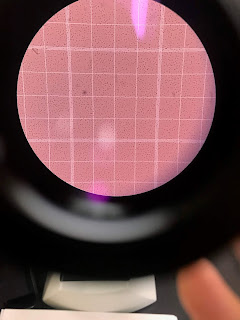
Today's lab was fairly short. April had me look at D.  rad and D. pima under the microscope using a hemocytometer slide. We usually stain the cells but today we did not because April just wanted to take a look at them. However, next week we are going to actually count them once we have conducted our assay's. Below is an image of what a hemocytometer slide looks like. The cells on the slide are D. rad.

Lab 10/05/19

Today, I assisted Shawn with his project which has to do with  V. fischeri. We made twelve serial dilutions consisting of algae and lysade and then ran a standard curve with a 96 well plate. In hopes to see how V. fischeri  luminescence is effected.

Lab 10/01/19

In today's lab, I made 50mL of Tris HCl buffer in preparation for the assay we are going to run on Friday. I also made two more 1:1000 dilutions. Other than that today's lab was quite fast.